
Morgan Barbeau, July 2026
Ed Emory needs no introduction. Having guided on the South Fork of the Snake River in Idaho for 36 years and counting, it’s fair to say Ed knows this fishery — and big trout in general — like the back of his hand.
In case you need more evidence: he’s won the Jackson Hole One Fly event not once, not twice, but five times. He’s also earned the Carmichael Award, which recognizes excellence in guiding. He averages 160 days a year on the water and has rowed his drift boat over 67,000 river miles with clients — roughly 2.8 times around the world.
His most recent recognition came when he guided client Caroline Langdale onto a 30.5″ brown trout that, on July 1st, 2026, officially earned the Idaho state record for catch and release.
The rod that landed that fish — and Ed’s rod of choice for guiding every day? The Douglas Sky G 4104 10′ 4wt. In a world where the 9′ 5wt reigns supreme for most trout applications, we had to find out why.
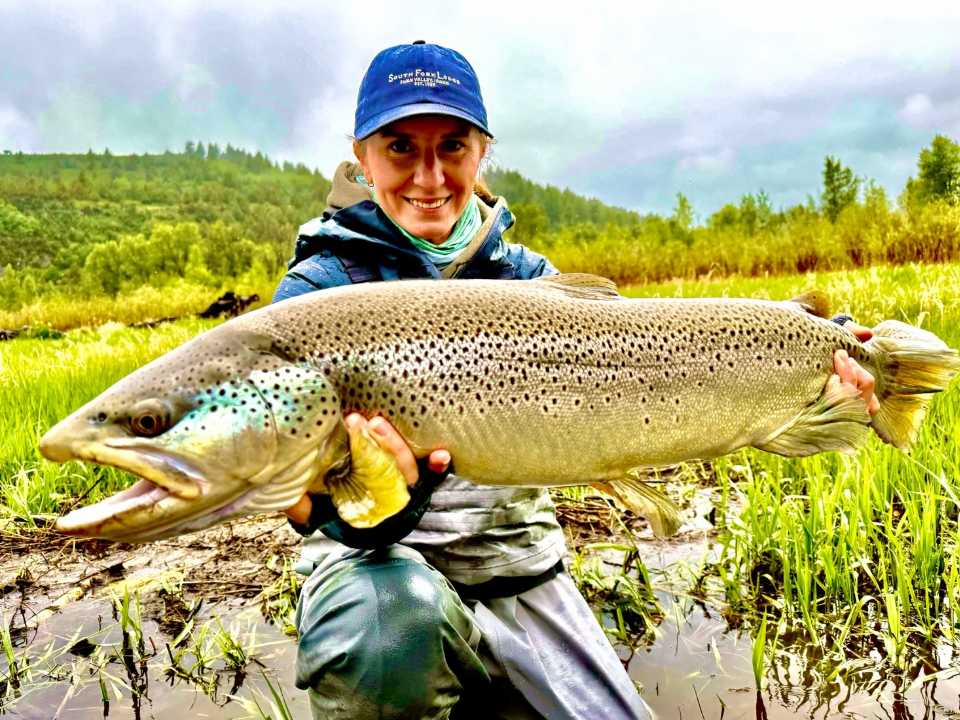
Langdale with her state record brown
Feel First
Ed takes a tactile approach to teaching fly casting. Rather than drilling new anglers on classic principles like keeping a stiff wrist or throwing tight loops, he focuses on finding the right tools that give anglers immediate, physical feedback.
“You can teach them all you want, explain all you want, but at the end of the day, people need to be able to feel what they’re doing — and the 10′ 4wt helps with this learning curve exponentially,” he says.
That philosophy extends to how he thinks about casting instruction more broadly. Many of the rules taught to beginning fly anglers, he argues, are artifacts of older tackle rather than timeless truths.
“We teach no wrist because when we fished bamboo rods, they were so soft. If you cast with your wrist, you’d lose the rod’s ability to hold energy and get waver in the rod. A stiff arm was required. But with modern graphite, the game changed.”
A Larger Window for Success
Ed loves guiding with a 10′ rod because it gives anglers — beginner or advanced — a more forgiving casting experience. The extra length creates a larger “sweet spot,” widening the window for a successful cast. Rather than focusing on the hard stop points of 10 and 2 o’clock taught in traditional overhead casting, that window opens up to 9:30 and 2:30.
The added length also makes a meaningful difference when it comes to mending, roll casting, and waterloading. Ed will often put a 5wt line on the rod to achieve better loading and control, helping anglers reach further and punch through windy conditions with less effort.
“It allows a beginner to achieve what they want in a cast without them fully understanding what’s actually going on — whether the angler is a visual, tactile, or verbal learner,” he explains.
The longer rod also protects the tippet, allowing anglers to fish smaller diameters with less risk of breakage, while shortening the time needed to fight, land, and release a fish. That’s a win for less experienced anglers managing a big fish for the first time, and it’s especially important in warmer water temperatures when fish need to be handled quickly.
Presentation, Presentation, Presentation
Ask Ed about the key to successful fly fishing and he doesn’t hesitate: his three P’s are presentation, presentation, and presentation. Mending, reading water, choosing the right fluorocarbon diameter, and fishing a rod that isn’t bulky — all of it feeds into how well you put the fly in front of the fish.
Of those elements, reading water is, in his view, the hardest skill to develop. Ed studied freshwater biology in college after initially pursuing a pre-med track, which gave him a strong foundation in fish behavior. But it was hydrology — understanding what the water itself does to deliver food to fish — that proved to be the deepest and most valuable education.
His approach to guiding reflects that same focus on the fundamentals of angling. “Organic growth as a young guide, and not tolerating failure,” is how he describes his development. He even taught himself to cast left-handed so he could experience the same struggles his clients face — and became a better teacher because of it. “We’re top-down people by nature. We expect people to conform to us. As a guide, you need to conform to your client.”
What’s Next
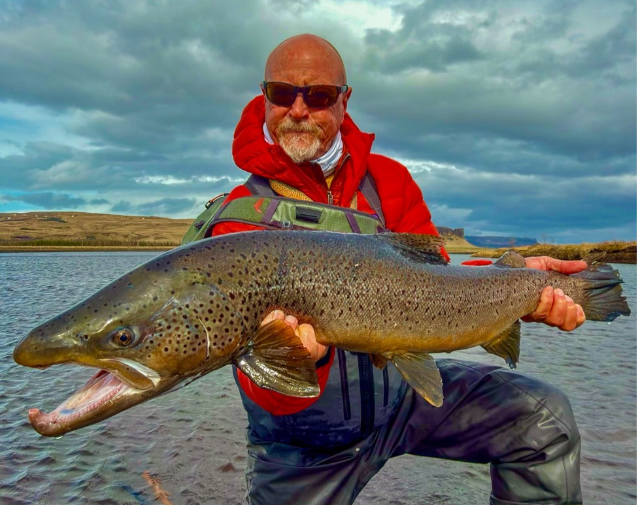
While the 10′ 4wt is Ed’s near-constant companion on the water, there is one exception: Iceland. An admitted fanatic for the fishery there, Ed landed a 36″ brown trout on his most recent trip — and he’s already setting his sights on a 40-incher. For those pursuits, he reaches for a 7wt switch rod. It’s the one scenario where he’ll willingly step away from the 4wt.
Thirty-six years in, 67,000 miles rowed, and a state record on the books — and Ed Emory is still chasing the next big fish.